| | | | Poodle Information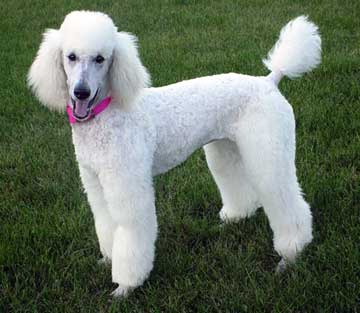
Poodle Facts | Size | Medium | | Male Max Weight | 45-65 lb | | Female Max Weight | 45-65 lb | | Life Span | 10-13 years | | Energy Level |  | | Ease of Training |  | | Grooming | | | Shedding | 
| | Exercise Requirements | 
| | Playfulness |
| | Affection Level |
| | Good With Dogs |
| | Good With Pets |
| | Good With Strangers |
| | Watchdog Ability |
| | Protection Ability |
| | Cold Tolerance |
| | Heat Tolerance |
|
Poodle Temperament | The Miniature Poodle is a high energy, intelligent, and compliant breed. It has been and remains one of the most popular breeds of dog. The Miniature Poodle can be sensitive. It is a breed that commits to its owner and can be timid around people it does not know. The Miniature Poodle had a tendency to be well-behaved with children, other pets, and other dogs. It can have a propensity to bark. The Standard Poodle is a highly intelligent and well-mannered dog. It is often playful, yet inquisitive. When outside, the Standard Poodle enjoys the opportunity to run, swim, and retrieve. This breed is good with children, other pets, and other dogs, but can be more reserved with people it does not know. | Poodle Upkeep | The Poodle requires a significant amount of socialization with people. This breed also needs exercise physically and mentally. The physical exercise requirements can be satisfied with short play sessions or games in conjunction with a daily walk. The exercise needs of the Standard Poodle may be more demanding. The Poodle cannot survive in an outdoor environment and should live indoors. The maintenance of the coat can require daily brushing depending on the length of the coat. The hair of the breed collects in the hair surrounding it when it is shed, thereby creating the potential for matting. Pet clips can help to maintain this coat and can be performed every four to six weeks. | Poodle Health | There are several major health concerns for the Poodle, which include PRA (progressive retinal atrophy), Legg-Perthes, patellar luxation, and epilepsy. Some of the minor health concerns for this breed include trichiasis, entropion, lacrimal duct atresia, cataracts, glaucoma, and distichiasis. On occasion, urinary stones and intervertebral disk degeneration is seen in the Poodle. To keep this breed healthy, regular testing of the eye, knee, hip, and DNA is suggested. The average life span of the Poodle is 13 to 15 years. | Poodle History | It is believed that the Poodle has its origins and ancestors in central Asia, but many people associate the breed with France. The initial manifestation of this breed is thought to be the Barbet, which was found in France, Russia, and Hungary. The German version of the Barbet is thought to have the most influence on today’s Poodle with the word Poodle having roots to the German word pfudel. The French version was known as the caniche or chien canard. Many of the definitions of these words were related to the water and hunting abilities of the breed. The Poodle had many useful functions including being a guard dog, a wagon puller, a circus performer, and a military dog. The traditional puffs of hair of the Poodle have been thought to be for protection while hunting, but other verification exists detailing how it was decoration for performing. Eventually the Poodle became a fashion item for women and made its way to the likes of French aristocrats. The breed even gained notoriety as the national dog of France. Towards the end of the 1800s, the Poodle became a show dog. The hair of the Poodles that were originally shown was often left matted as opposed to brushed out. This trend eventually phased out and at the beginning of the 1900s, the brushed out style became the popular trend. The Poodle’s popularity was diminishing in America during this time and by the 1920s, but quickly made a comeback to become the most popular dog in America by the 1930s. | Poodle Pictures | Puppies 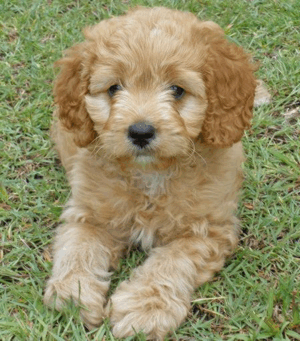
Middle Aged 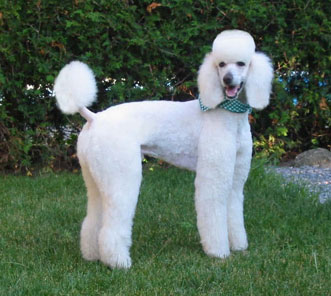
Older 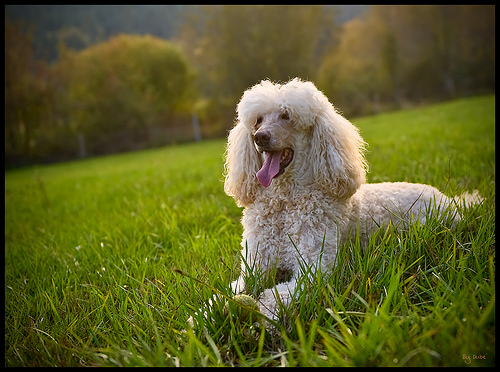
| Poodle Videos
|
| |